I’m grateful to have won 3rd place and the Nicati-De Luze Prize in the composition category of the 78th Concours de Genève with my piece 『The Past Recaptured』, which was performed as a viola concerto by Lise Berthaud.
In 2017, while I was uncertain about my future, I began learning composition at the relatively late age of seventeen. That same year, I discovered the three finalists of the 72nd Concours de Genève and was deeply moved by their clarinet concertos: Jae-Hyuk Choi, Yair Klartag, and Han-Kyeol Yoon. It took me a long time to fully understand their contemporary music, but seeing them express their ideas through music and receiving applause from the audience made me dream of standing on that stage one day.
I can confidently say that their performances inspired my own dreams. I was a young admirer of those composers at the Competition. And seven years later, I applied to the 78th Concours de Genève with my piece 『The Past Recaptured』.
From the announcement of the competition rules last December, to hearing that I was selected as a finalist in June, and finally experiencing the past week of competition events, it has all felt like a dream. It was also a time for me to reflect on the 7-8 years that have passed since I decided to learn a composition back in 2017.
I also learned a great deal from the music of Caio de Azevedo and Léo Albisetti, who won the 1st Prize Ex Aequo. I will never forget the warmth and kindness of both composers.
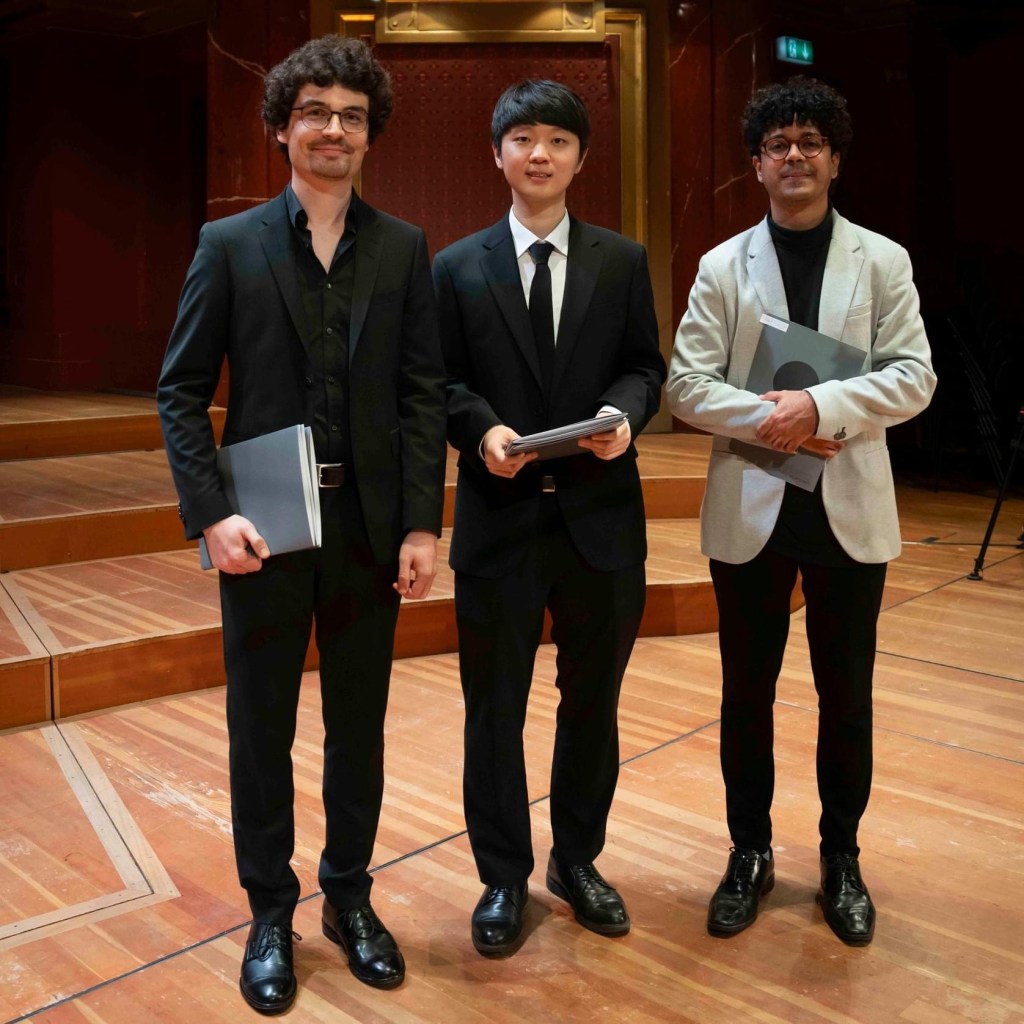
Caio perfectly controlled the ‘space’ of the stage, and his piece was a milestone in exploring the possibilities of the viola, based on his profound understanding of string instruments.
Léo, on the other hand, crafted a 12-minute piece using the simplest musical materials, and from this, I learned the craftsmanship he mentioned in his interview.
I want to sincerely thank everyone who listened to 『The Past Recaptured』 and supported me throughout this long journey.
[Program Note]
“(…) a work of art is the only means of regaining lost time. And I understood that all the material of a literary work was in my past life.” (Proust, ≪In Search of Lost Time≫)
French novelist Marcel Proust (1871-1922)’s last volume of the novel ≪In Search of Lost Time (fr: À la recherche du temps perdu)≫ is titled ≪Le Temps retrouvé≫. It is translated into English as ‘Time Regained’ or ‘The Past Recaptured.’ However, I chose to embark on the adventure of using ‘The Past Recaptured’ instead of the commonly known ‘Time Regained.’ The prefix ‘re-‘ in both titles faithfully encompasses something lost. But, if what is lost and retreived is an impression preceding time itself, then ‘recaptured’ might be more suitable than ‘regained’.
In ≪In Search of Lost Time≫, there are two distinct narrative voices—the Hero (Marcel) and the Narrator—and both are clearly different. Finally, both the hero’s lived experience and the narrator’s thoughts lead them to the writer’s vocation. Marcel, the hero, assimilates numerous signs throughout his journey, which begins in the bedroom in Combray. The events he encounters are positioned under the double signs of disillusionment and detachment, and of decay and death, as described by Ricoeur.
However, as Marcel steps on the flagstone at the Guermantes’ mansion, he feels as though many other sensations are being synthesized. At that moment, the focus of ≪In Search of Lost Time≫ shifts from the apprenticeship to signs to the visitation. He realizes that all the material for a literary work was in his past life. This idea of time warned him that the hour had come to set himself to writing as an author. My work, 『The Past Recaptured』, can also be seen as starting from that circumstance.
For a long time (Longtemps), I have dreamed of creating a single work that could encapsulate my life. It truly begins only when faced with the necessity of ‘must write,’ not merely the desire to ‘want to write’, just as Marcel shifts from the apprenticeship to signs to the visitation. The main motif of this piece is the glissando, and it begins with a pedal glissando on the timpani. The glissando is not simply a carrier of pitch; it acts as a gesture reminiscent of the past. The solo viola mimics these gestures, singing various forms of glissandi, and often, the sound of tubular bells awakens our pasts.
Sometimes, the process of Recapturing is arduous. The lines formed by the glissandos intertwine and emit various signs. Then, have I, like the hero-narrator, overcome the vocation of a composer? The coda of 『The Past Recaptured』 resonates with the echoes of a 15-minute journey traversed. After the melody of the viola, burdened with that weight, has faded away, I might come to understand. (As Deleuze would say) The time I thought was spent in vain was also a process of apprenticeship — in time (dans le Temps).
 Sangmin Ryu
Leave a comment