2025
『The Chronicles of Time – I. Heraclitus』 for orchestra
“On those stepping into rivers staying the same other and other waters flow.” (DK22B12)
Remark :
Heraclitus saw the constantly changing world as a flowing river. In this process of movement, even the identity of things (like the river itself) is actually dependent on change (the water). Furthermore, spatial and temporal things contain opposing characteristics within themselves, and these opposing qualities also undergo change.
For example, this piece begins in D♭ and flows between nearby pitches, creating a sense of fluid movement. However, the D♭, which seemed constant, undergoes transformation over the course of ” time,” reflecting the flow and change inherent in Heraclitus’ s concept. Additionally, from measure 11 , the woodwinds attempt to sustain the same pitch, yet subtle shifts occur despite their effort to maintain constancy.
Ultimately, all movement converges at Letter C, where the strings play an F♯. However, this note undergoes variation through diverse vibrato techniques, embodying continuous transformation.
— 2025.12 / RSH Orchesterlesungen

『Dialogues』 for Two Harps and Ensemble
— Commissioned by the Nicati-de-Luze Prize
2024
『The Past Recaptured』 for solo viola and chamber orchestra
“(…) a work of art is the only means of regaining lost time. And I understood that all the material of a literary work was in my past life.”1
French novelist Marcel Proust (1871-1922)’s last volume of the novel «In Search of Lost Time (fr: À la recherche du temps perdu)» is titled «Le Temps retrouvé». It is translated into English as ‘Time Regained’ or ‘The Past Recaptured.’ However, I chose to embark on the adventure of using ‘The Past Recaptured’ instead of the commonly known ‘Time Regained.’ The prefix ‘re-‘ in both titles faithfully encompasses something lost. But, if what is lost and retreived is an impression preceding time itself, then ‘recaptured’ might be more suitable than ‘regained’.
In «In Search of Lost Time», there are two distinct narrative voices—the Hero (Marcel) and the Narrator—and both are clearly different. Finally, both the hero’s lived experience and the narrator’s thoughts lead them to the writer’s vocation. Marcel, the hero, assimilates numerous signs throughout his journey, which begins in the bedroom in Combray. The events he encounters are positioned under the double signs of disillusionment and detachment, and of decay and death, as described by Ricœur2.
However, as Marcel steps on the flagstone at the Guermantes’ mansion, he feels as though many other sensations are being synthesized. At that moment, the focus of «In Search of Lost Time» shifts from the apprenticeship to signs to the visitation. He realizes that all the material for a literary work was in his past life. This idea of time warned him that the hour had come to set himself to writing as an author. My work, 『The Past Recaptured』, can also be seen as starting from that circumstance.
For a long time (Longtemps), I have dreamed of creating a single work that could encapsulate my life. It truly begins only when faced with the necessity of ‘must write,’ not merely the desire to ‘want to write’, just as Marcel shifts from the apprenticeship to signs to the visitation. The main motif of this piece is the glissando, and it begins with a pedal glissando on the timpani. The glissando is not simply a carrier of pitch; it acts as a gesture reminiscent of the past. The solo viola mimics these gestures, singing various forms of glissandi, and often, the sound of tubular bells awakens our pasts.
Sometimes, the process of Recapturing is arduous. The lines formed by the glissandos interwine and emit various signs. Then, have I, like the hero-narrator, overcome the vocation of a composer? The coda of 『The Past Recaptured』 resonates with the echoes of a 15-minute journey traversed. After the melody of the viola, burdened with that weight, has faded away, I might come to understand. (As Deleuze3 would say) The time I thought was spent in vain was also a process of apprenticeship — in time (dans le Temps).
Short Version (EN / FR) : 『The Past Recaptured』 draws from Marcel Proust‘s ≪In Search of Lost Time≫, using glissando motifs that evoke various signs. It reflects a journey from the apprenticeship of signs to the visitation, paralleling Proust’s realization that all material for a literary work was in his past life.
[1] Proust, Marcel. In Search of Lost Time. Translated by
[2] Ref. Ricœur, Paul. Time and Narrative (Temps et Récit).
[3] Ref. Deleuze, Gilles. Proust and Signs (Marcel Proust et les signes).
— 2024.10.20 / Victoria Hall (Genève, Switzerland) [Premiere]
2022
『Différence et répétition』 for Viola and Piano
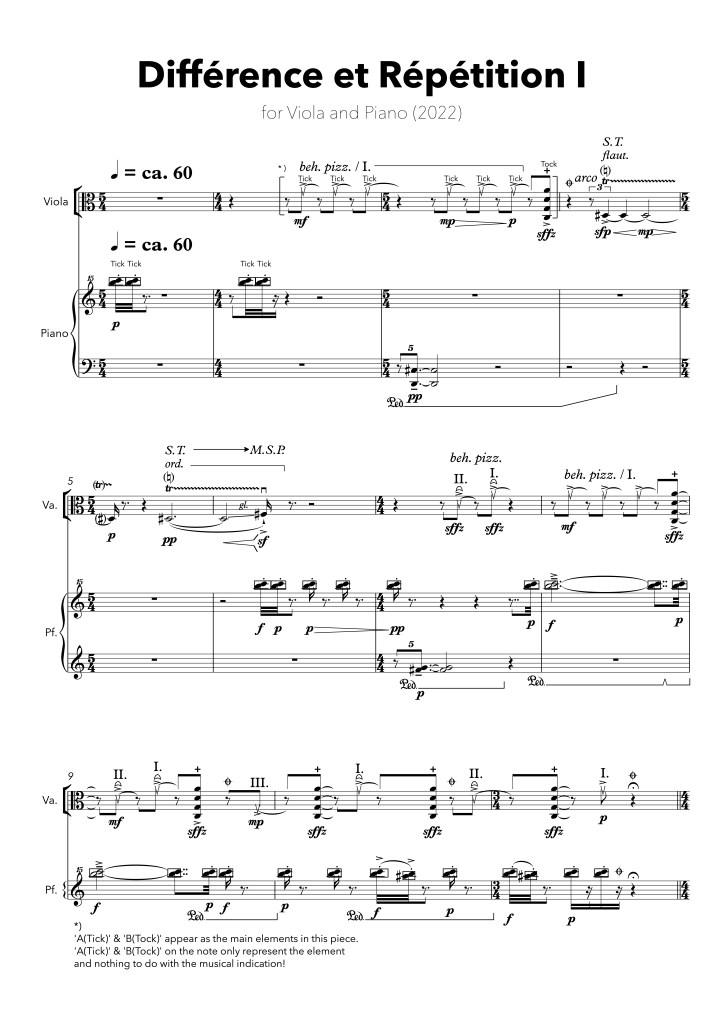
“One refers to a repetition of elements of the type AAAA… (tick,tick,tick,tick …), the other to a repetition of cases such as AB AB AB A … (tick-tock, tick-tock, tick-tock, tick …).”1
Gilles Deleuze (1925 ~ 1995) distinguishes between the examples of the two philosophers (Bergson, Hume) on repetition in Hume‘s thesis: “Repetition changes nothing in the object repeated, but does change something in the mind which contemplates it.”.
Bergson‘s example is a closed repetition with ‘A (tick), A (tick), A (tick), A (tick) …’ and repeats of elements, Hume’s example is ‘AB (tick-tock)’ , AB (tick-tock), AB (tick-tock), AB (tick-tock)…’ and is distinguished as open repetition and repeats of cases.
In this piece, closed repetitions ‘A (tick), A (tick), A(tick)…’ and open repetitions ‘AB (tick-tock), AB (tick-tock), AB (tick-tock)…’ are used as major musical materials. In open repetition, AB(tick-tock), the appearance of A (tick) makes us expect the appearance of B (tock), and the fusion of AB (tick-tock) is a contraction and passive synthesis, forming a kind of habit. Habits steal new differences from repetition, and the soul that gazes at them contracts them. In this piece, various musical events and differences were attempted through qualitative transformation of the order of repetition as described above.
[1] Deleuze, Gilles. Difference and Repetition. Translated by Paul Patton, Columbia University Press, 1994, p. 70.
— 2022.10.18 / IPAC Hall (Seoul, Korea) [Premiere]
— 2024.02.20 / Sejong Center Chamber Hall (Seoul, Korea)
— 2024.10.20 / Conservatoire de Genève, Salle Franz Liszt (Genève, Switzerland)
『Flügel des Ikarus: Flucht in die Freiheit』 für Klavier und Ensemble
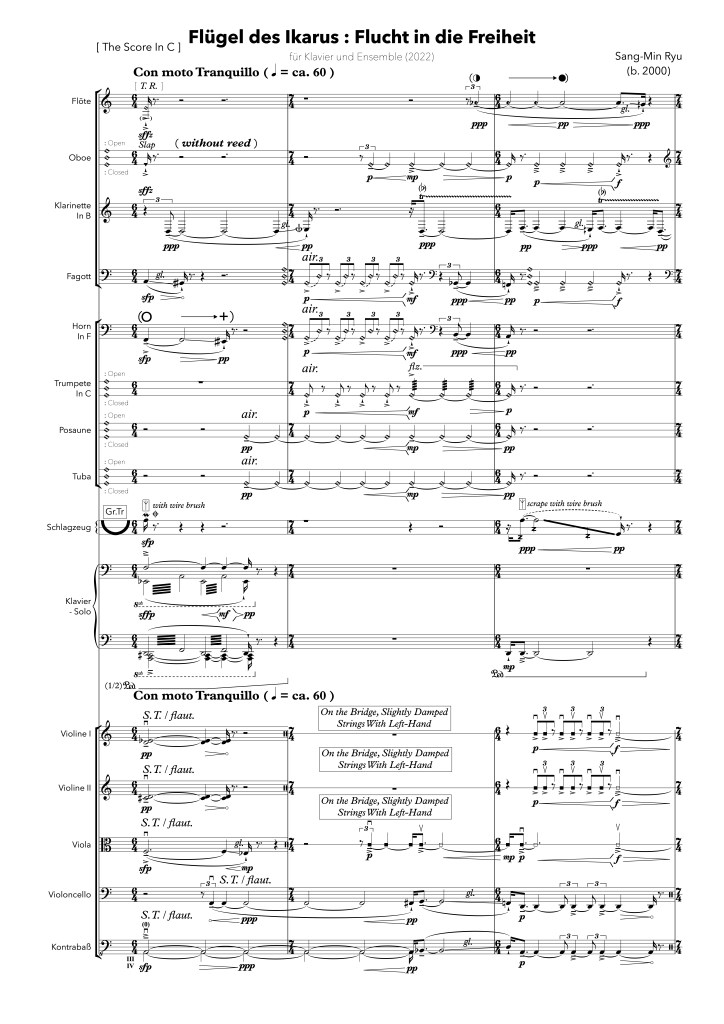
In 『Flügel des Ikaus: Flucht in die Freiheit』 for piano solo and ensemble, I break away from the speculative or abstract materials I was usually interested in and focus on more concrete ideas, drawing inspiration from real materials. Based on this, I musicalized ‘The Flight of Icarus’ from the Story of Daedalus and Icarus in Greek mythology.
What is the value of Freedom? Are there limits to Freedom? In the myth of Icarus, I focused on the value of freedom. His wings melt from the heat of the sun when he flies too hight and are damaged by the dampness of the sea when he flies too low. The balance between freedom and indulgence is the only way he can fly safely. It is the duty of an existential human being who possesses freedom.
I interpreted the death of Icarus from a fall into the sea as the necessity of freedom. This piece abstractly and realistically describes Icarus flying freely with wings and his eventual death by falling into the sea. Icarus’s desire for Freedom is expressed by using trills in woodwind, bisbigliando, and vibrato in string as the main materials. In addition, the multiphonics of the woodwinds metaphorically express a warning of the danger of falling.
— 2022.09.01 / Tongyeong Concert Hall, Black Box (Tongyeong, Korea) [Reading Session]
— 2022.10.19 / Paiknam Music Hall (Seoul, Korea) [Premiere]
2021
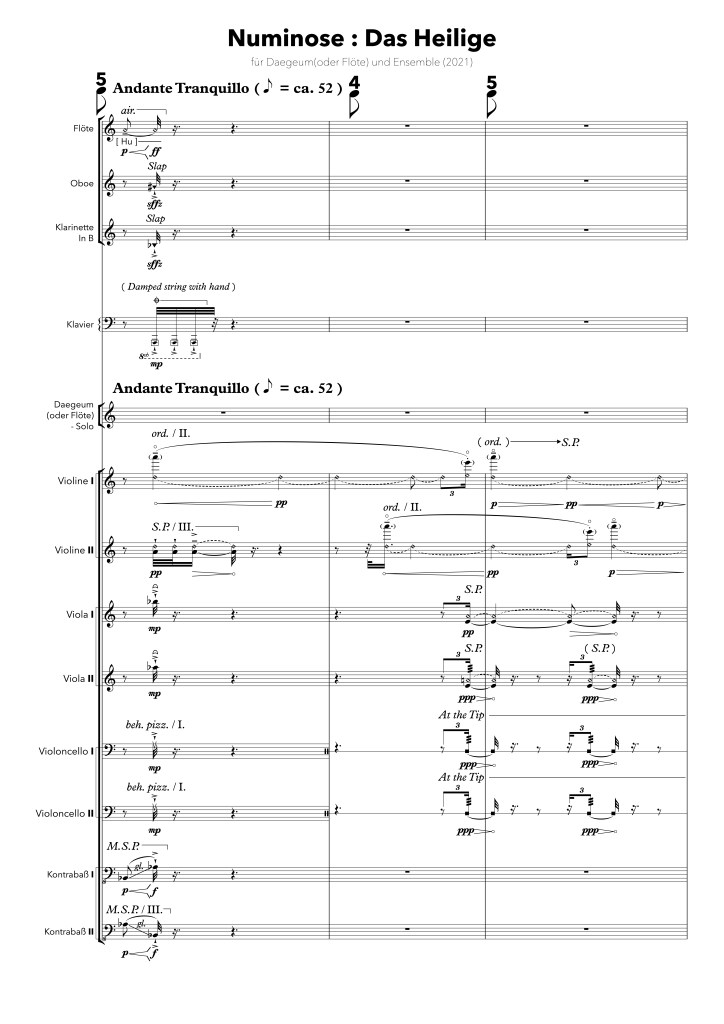
『Numinose : Das Heilige』 für Daegeum(oder Flöte) und Ensemble
The 20th-century German theologian, philosopher and comparative religious scholar Rudolf Otto (1869 ~ 1937), published ≪The Idea of the Holy: An Inquiry into the Non-Rational Factor in the Idea of the Divine and its Relation to the Rational≫ in 1917, presenting a unique human experience found in all religions.
Also he proposed the concept of holiness, which was comprehensively accepted as a religious experience unique to human beings. He posits that there are irrational elements in religion that transcend clear conceptual understanding and verbal expression, and explains the irrational aspect of religious ideas as the numinose. Numinose can be summarized as ‘awe and fear’ that evokes creaturely emotions, ‘fear of the Absolute other’ that evokes fascination, ‘overwhelming authority’, and ‘mystery’. It argues that Numen’s senses are inherent a priori.
This work is developed according to the temporal and spatial flow inherent in the concept based on the aforementioned Numinose. Transcending individual beliefs and religions, human beings can be said to be homo religious in their exploration of the meaning of life. This piece, starting with the faint sense of the string instrument group, raises existential questions based on the numinose, centering on the flute as a solo instrument. The ultimate goal of this piece is for the audience to have a musical experience in which the concept of holiness leads to reflection on individual life while listening to this music and experiencing the subject of numinose.
— 2022.01.12 / Daegu Concert House, Chamber Hall (Daegu, Korea) [Premiere]
『The Shipwreck』 für Bläserquintett
In this piece of music, the composer sought to derive ideas from more real or tangible materials, moving away from the speculative or abstract subjects typically used in creation. Based on this approach, the composer turned to visual art, specifically painting, and transformed ≪The Shipwreck≫, a work completed in 1805 by the British Romantic painter William Turner (1775-1851), into music.
In ≪The Shipwreck≫, the depiction of a ship being swept away by waves and chaos is dynamically expressed. Using the still situation captured in this painting as a reference, I aimed to express various musical ideas by deconstructing the plots composed by the surrounding context in detail. In the process of a ship meeting a storm and becoming a wreck, the instruments that make up the woodwind quintet (flute, oboe, clarinet, horn, and bassoon) were assigned different roles or personalities. Based on the unique characteristics of the woodwinds, the piece directly simulates specific sounds and sometimes alludes to the broader contexts inherent in the painting.
The composer hopes that listeners will be immersed in the pure aesthetic experience of projecting the shipwreck that William Turner envisioned on the canvas about 200 years ago through this music.
[The 53rd Seoul Music Festival, Excellence Award in Chamber Music (2021.07)]

『Duo』 für Flöte und Klavier
This piece was composed based on the French philosopher Henri Bergson (1859-1941)‘s concept of Élan vital, which means vital impetus (or vital force). However, it does not mean that élan vital is expressed directly through the piece; rather that it is operated as a major characteristic inherent in the interaction of the two instruments.
The piano’s attack, which varies in various forms, serves as a condition for condensing fundamental forces, while the flute’s gesture, which causally engages with it, represents the process of these condensed forces vibrating. The ultimate intention of the composition is for listeners to capture the implications of the relationship inherent in the interaction between the two instruments and the various dynamics expressed by the flute.
— 2022.07.22 / Dream Forest Art Center (Seoul, Korea) [Premiere]
— 2022.11.07 / Paiknam Music Hall (Seoul, Korea)
— 2024.10.20 / Conservatoire de Genève, Salle Franz Liszt (Genève, Switzerland)

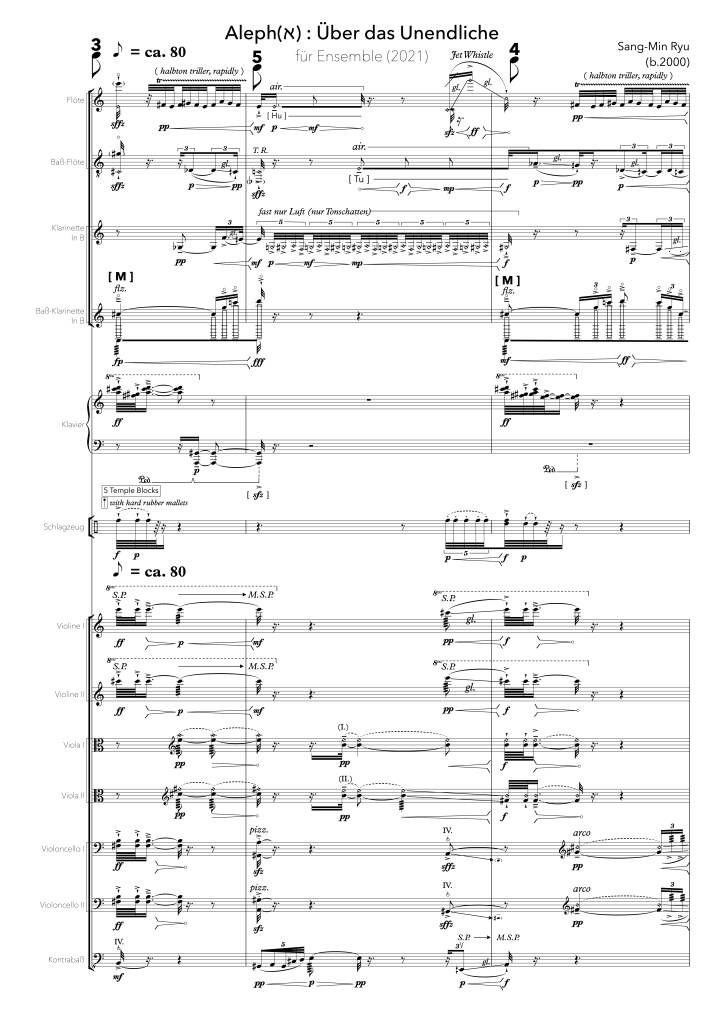
『Aleph(א): Über das Unendliche』 für Ensemble
The concept of infinity has been anticipated and applied in various fields, both in the East and West. In mathematics, the Aleph (ℵ) number is a notation devised by the mathematician Georg Cantor (1845-1918) to represent the cardinality of infinite sets in set theory.
For example, ℵ0 is the size of a countable infinite set and represents the size of the set of natural numbers, while ℵ1 (= 2ℵ0) is the smallest uncountable infinite set and represents the size of the set of real numbers, irrational numbers, and complex numbers. This generalized notion, ℵn+1 (= 2ℵn), is known as the general continuum hypothesis. This means that even within the concept of ‘infinity,’ which extends endlessly, there are numerous systems with different cardinalities, sizes, and dimensions.
『Aleph (ℵ): Über das Unendliche』 is a piece that explores cardinality and size within the concept of infinity (Aleph number). The intense attack at the intro, which serves as the motif of this piece, creates a kind of resonance, producing infinite waveforms of different concentrations. These waveforms develop with varying sizes and magnitudes, reaching their peak through the bass drum in “Chaos, Allegro e religioso” before finally resolving. At the end of the piece, the leaping phrase of the flute concludes with a linear movement, expressing the concept of infinity.
— 2022.08.18 / Seoul Art Center (Seoul, Korea) [Premiere]
— 2022.08.19 / Gyeonggi Arts Center, Arts Hall (Suwon, Korea)
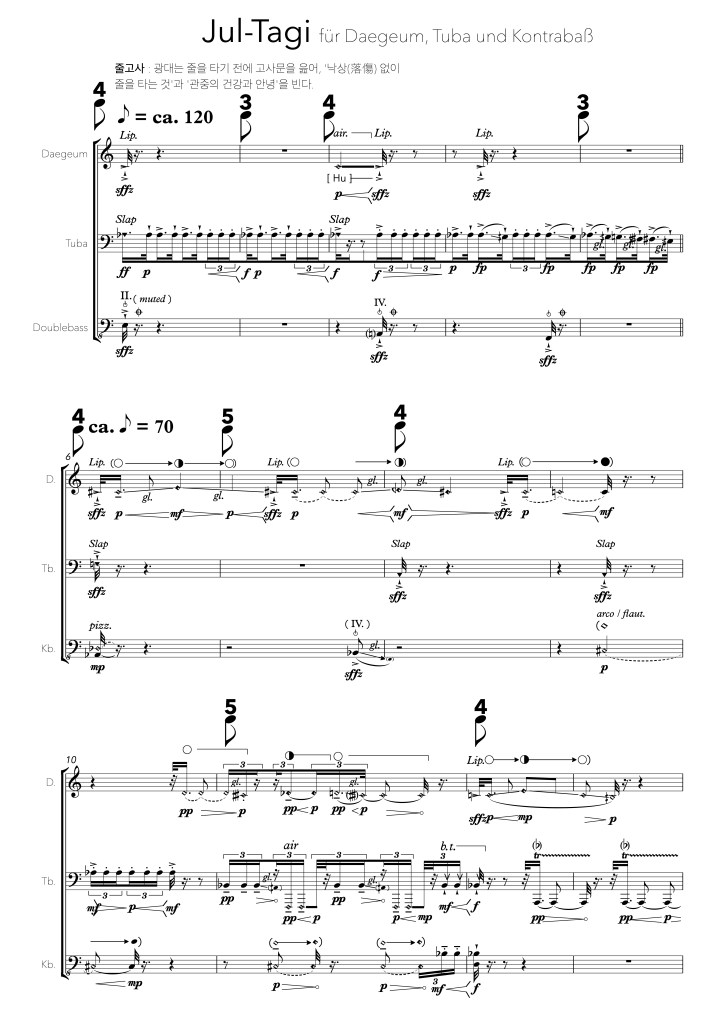
『Jul-Tagi』 für Daegeum, Tuba und Kontrabaß
In Korea, Jul-tagi (Tightrope Walking) is a performance in which a tightrope clown performs various tricks on a bare rope in the air, accompanied by the Samhyeonyukgak1—an ensemble of Korean-style wind instruments—along with witticisms, dancing, and shouting together with the clown.
Reflecting on vague memories of watching a tightrope walking performance as a child, I recombined the elements of this traditional play.
[1] The Samhyeonyukgak (Korean: 삼현육각) ensemble is composed of two hyangpiri (Korean: 향피리)—a double-reed instrument, a daegeum (Korean: 대금)—bamboo flute, a haegeum (Korean: 해금)—two-stringed fiddle, a janggu (Korean: 장구)—an hourglass-shaped drum, and a buk (Korean: 북)—a barrel drum.
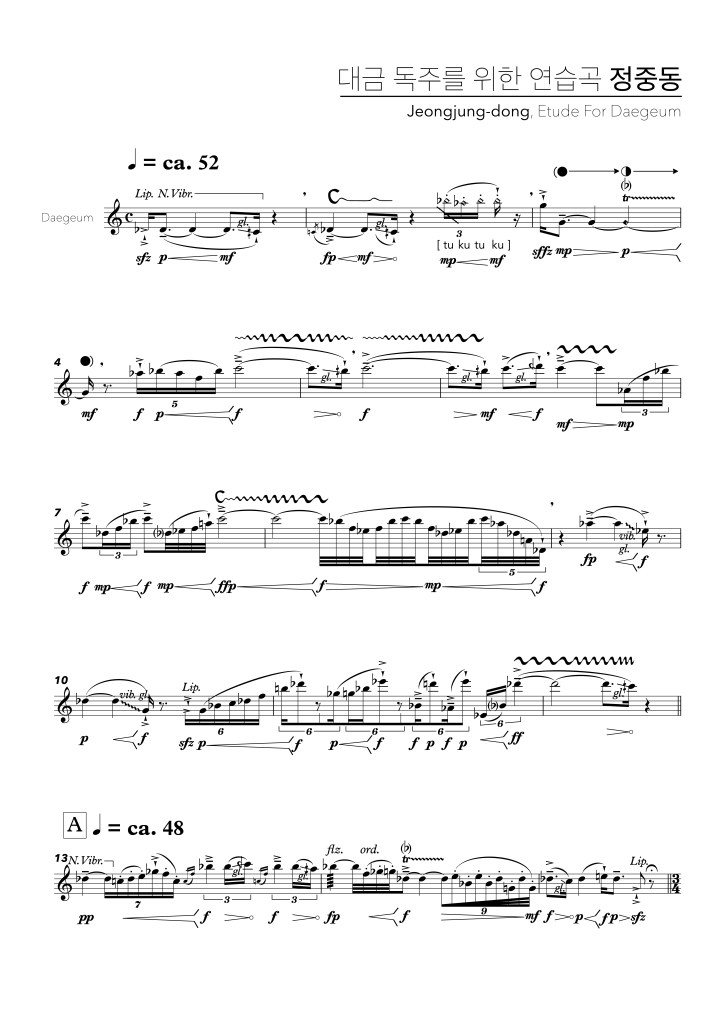
『Jeongjung-dong』, Etude for Daegeum
This piece is developed based on the Taoist concept of stillness in motion (Korean : 정중동), a characteristic found in Korean martial arts and dance. Additionally, it aims to integrate ‘Korean traditional music’ and ‘Western music’ by applying special techniques of Western wind instruments to the traditional Korean instrument, the daegeum.
Finally, through the brush-like figurative sound patterns played by the daegeum, my intent is to highlight the vitality of individual sounds within the theme of still in motion.
[The 13th Sinakhoe (Korean : 신악회) Composition Competition (2022.07) ]
— 2021.09.27 / Paiknam Music Hall (Seoul, Korea) [Premiere]

2020
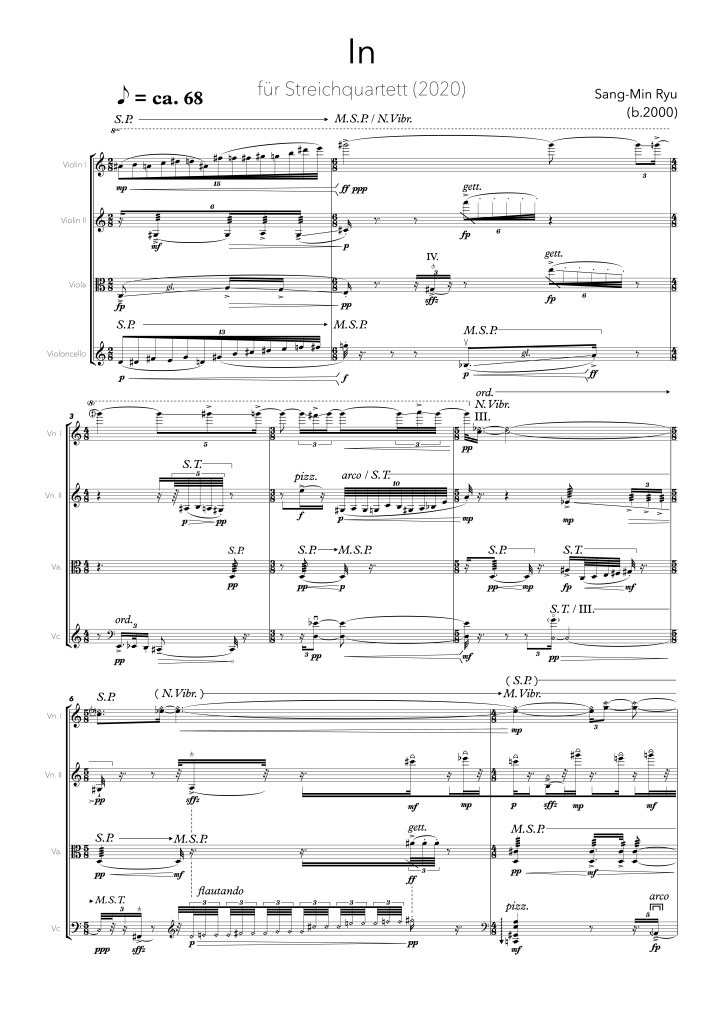
『In』 für Streichquartett
≪Black in Deep Red≫ is a painting by American abstract painter Mark Rothko (1903-1970) from 1957. I concentrated on the preposition ‘in’ in this painting. ‘In’ is a preposition indicating an abstract or physical range.
Focusing on ‘in’ also shows that ‘Red’ is a leading factor and ‘Black’ is a trailing factor in this picture.
In other words, ‘Red’ is subordinate to ‘Black’. In this relationship, I composed the piece with the attributes ‘Status (Stopped State)’, ‘Process (Moving State)’, and ‘Result (Stopped State)’, which represent the space of ‘in’.
— 2020.11.24 / Hanyang University (Seoul, Korea) [Reading Session]
『Lumi signifie la neige』 for Piano
“The snow is white, Lumi is black. Little girl, where are you going?” asks the crow. Lumi searches for his friend’s house. But how to find it without the sun. In this country, everything is black. In this country, everything is white. Lumi means know in Finish, in Santa’s country, where everything is cold.”1
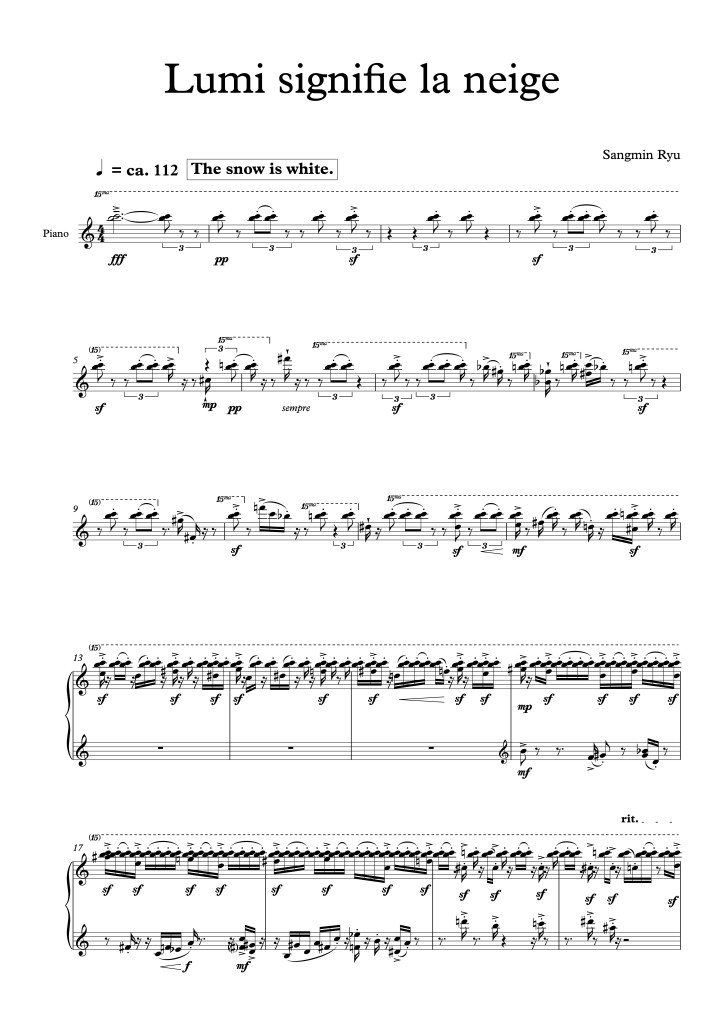
『Lumi signifie la neige』 begins with the chord ‘B + C’ in a half-tone relationship, which expresses a landscape covered with snow. This chord in the high range acts as a material that permeates the entire piece, represented by a plot structure in which Lumi finds her identity (or attribute).
The chords are composed according to the sequential flow of time in a fairy tale book and follow a transformed arch form structure:
<A – B – C – B’ – A’ – Coda>
‘Lumi signifie la neige’ is the part that depicts how Lumi finds her identity. Sections A and B express that Lumi is black, while the snow surrounding her is white. These contrasting attributes are divided into many leaps with fast notes and stepwise motion with slow ones.
In Section C, she asks where she is headed through the crow’s call. However, Lumi realizes that there is no such thing as the sun to light her way to her destination. These crow motives and Lumi’s footprint motives are arranged alternately to depict a conversation-like situation of question and answer.
In Sections B’ and A’, Lumi realizes that everything in this country is made up of black and white. Furthermore, in the Coda, she recognizes that her name derives from snow, with its white properties.
In the snowy landscape, the gentle breeze rises to staccato, and the strong wind descends to glissando. Between these sounds, the song ends with an inserted view of the scenery, indicating Lumi’s steps.
[1] L’Ami de Lumi. GRANDIR, 5 Sept. 2005
— 2020.06.11 / Paiknam Music Hall (Seoul, Korea) [Premiere]
 Sangmin Ryu